
Previous Year Questions 2026
Q1. Study the data of a State given below and answer the question that follow : [1 Mark]
Educational achievement of rural population of State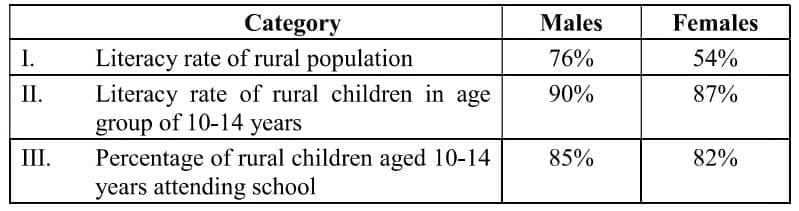 If rural children aged 10-14 years are considered, then how many female children are attending school ?
(A) 90
(B) 85
(C) 82
(D) 83
Ans: (C) 82
Q2. Which of the following organisations publishes the 'Human Development Report' ? [1 Mark]
(A) World Trade Organisation
(B) World Health Organisation
(C) United Nations Environmental Program
(D) United Nations Development Program
Ans: (D) United Nations Development Program
Q3. Which of the following organisations publishes the 'Human Development Report' ? [1 Mark]
(A) World Trade Organisation
(B) World Health Organisation
(C) United Nations Environmental Program
(D) United Nations Development Program
Ans: (D) United Nations Development Program
Q4. Why is sustainable development essential ? Explain with examples. [3 Marks]
Ans:
(i) Sustainable development is environment friendly economic development.
(ii) It is essential to conserve resources for future generation.
(iii) Resources are to be utilized in consonance with their availability.
(iv) Present requirements are to be managed in sustainable and judicious manner.
(v) Scientists, economists, philosophers and other social scientists are working together for sustainable development.
(vi) Groundwater is an example of renewable resources. These resources are replenished by nature as in the case of crops and plants.
(vii) Our future is linked with essential resources are getting depleted at a fast rate.
(Any three points to be explained)
Q5. Study the following table and arrange the States from lower to higher on the basis of 'Life Expectancy at Birth' and choose the correct option :
[1 Mark]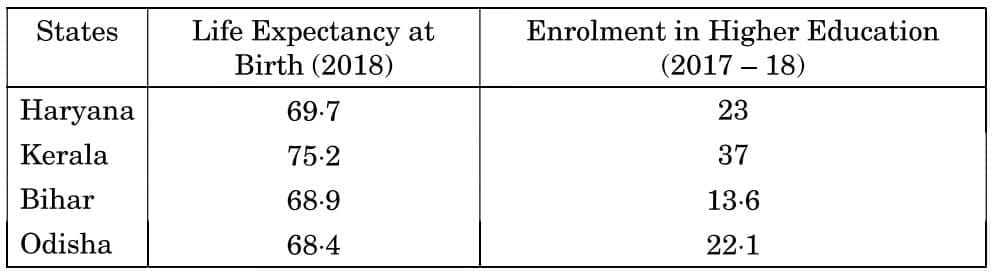 Options :
(A) Haryana, Kerala, Bihar, Odisha
(B) Kerala, Haryana, Bihar, Odisha
(C) Odisha, Bihar, Haryana, Kerala
(D) Odisha, Bihar, Kerala, Haryana
Ans: (C) Odisha, Bihar, Haryana, Kerala
Q6 Smt. Deepti is a resident of X country. Her country is a developed country. Which of the following would be a characteristic of her country ? [1 Mark]
(A) High Infant Morality Rate
(B) High Per Capita Income
(C) Low Literacy Rate
(D) Low Net Attendance Ratio
Ans: (B) High Per Capita Income
Q7. Define the term 'Body Mass Index'. Explain the method of its calculation. [3 Marks]
Ans:
Body Mass Index is the scale used by nutrition scientists to find out if we are properly nourished or not.
Method of calculation:
(i) It is calculated through the formula: Weight (in kgs) divided by Square of height (in metres).
(ii) If the height of the person is in centimetres, convert it into metres and divide the weight (in kgs) with the square of height (m2).
Q8. Define the term 'Body Mass Index'. Explain the method of its calculation. [3 Marks]
Ans:
Body Mass Index is the scale used by nutrition scientists to find out if we are properly nourished or not.
Method of calculation:
(i) It is calculated through the formula: Weight (in kgs) divided by Square of height (in metres).
(ii) If the height of the person is in centimetres, convert it into metres and divide the weight (in kgs) with the square of height (m2).
Q9. Define the term 'Body Mass Index'. Explain the method of its calculation. [3 Marks]
Ans:
Body Mass Index is the scale used by nutrition scientists to find out if we are properly nourished or not.
Method of calculation:
(i) It is calculated through the formula: Weight (in kgs) divided by Square of height (in metres).
(ii) If the height of the person is in centimetres, convert it into metres and divide the weight (in kgs) with the square of height (m2).
Q10. Define the term 'Body Mass Index'. Explain the method of its calculation. [3 Marks]
Ans:
Body Mass Index is the scale used by nutrition scientists to find out if we are properly nourished or not.
Method of calculation:
(i) It is calculated through the formula: Weight (in kgs) divided by Square of height (in metres).
(ii) If the height of the person is in centimetres, convert it into metres and divide the weight (in kgs) with the square of height (m2).
Q11. Study the given data carefully and answer the question that follows : [1 Mark]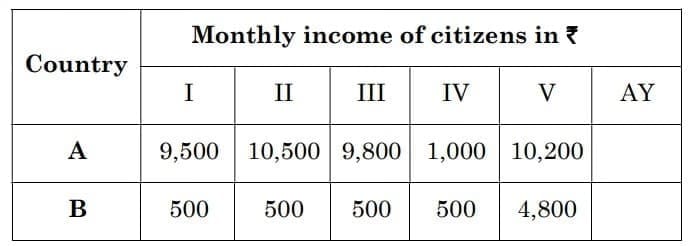 Identify the average monthly income of citizens in 'country A'.
(A) 8,200
(B) 9,000
(C) 1,000
(D) 9,020
Ans: (A) 8,200
Q12. Which of the following reports compare countries using health, education and per capita income ? [1 Mark]
(A) Human Development Report
(B) Global Trade Report
(C) World Development Report
(D) Economic Survey Report
Ans: (A) Human Development Report
Q13. Choose the correct option to fill in the blank : [1 Mark]
Net attendance ratio is expressed as a ________ of total children in the age group of 6 - 10 years attending school.
(A) Ratio
(B) Percentage
(C) Fraction
(D) Index
Ans: (B) Percentage
Q14. Analyse the issues that necessitate sustainable development for the future. [3 Marks]
Ans:
(i) Present model of development has damaged ecosystem and has polluted natural resources like air, water, land, soil etc.
(ii) Depletion of natural resources can threaten the availability for future generations.
(iii) Even renewable resources need to be used judiciously.
(iv) Rapid industrialisation and greenhouse gas emission has caused global warming.
(v) Deforestation is causing extinction of many species of plants and animals.
(Any three points to be explained)
Q15. Study the given data and answer the question that follow : [1 Mark]
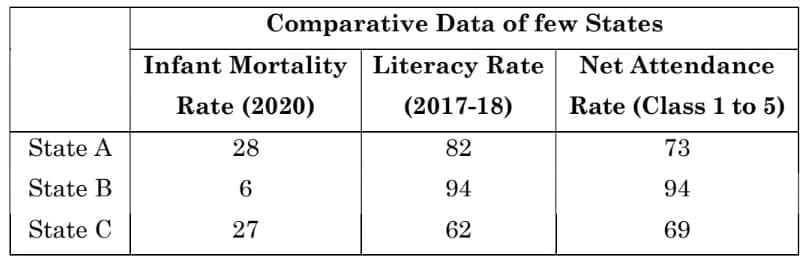
By how many of the following points does State B's literacy rate exceeds from State A in 2017-18 ?
(A) 12
(B) 10
(C) 16
(D) 14
Ans: (A) 12
Q16. Which of the following is an example of a renewable resource ? [1 Mark]
(A) Natural Gas
(B) Crude Oil
(C) Coal
(D) Ground Water
Ans: (D) Ground Water
Q17. Choose the correct option to fill in the blank : [1 Mark]
Infant Mortality Rate indicates the number of children that die before the age of _____ year(s) per 1000 live births in that particular year.
(A) One
(B) Two
(C) Three
(D) Four
Ans: (A) One
Q18. "Different persons can have different developmental goals." Explain the statement with examples. [3 Marks]
Ans:
(i) Aspirations and aims are different for all as development or progress means different to different persons.
(ii) For example- A landless rural labourer aspires to have more days of work and better wages; local school for quality education for their children; no social discrimination and opportunity to become leaders in the village.
(iii) Prosperous farmers from Punjab aspire for a high family income through higher support prices for their crops and through hardworking and cheap labourers so that they are able to settle their children abroad.
(iv) A girl from a rich urban family gets as much freedom as her brother and is able to decide what she wants to do in life. She is able to pursue her studies abroad.
(v) Two persons or groups of persons may seek things which are conflicting. A girl expects as much freedom and opportunity as her brother, and that he also shares in the household work. Her brother may not like this.
(vi) Similarly, to get more electricity, industrialists may want more dams. But this may submerge the land and disrupt the lives of people who are displaced - such as tribals. They might resent this and may prefer small check dams or tanks to irrigate their land.
(vii) Sometimes, what maybe development for one may not be development for the other. It may even be destructive for the other.
[Any three points to be explained.]
Previous Year Questions 2025
Q1: Amongst the given countries, which one has the highest rank in 'Human Development Index'? (1 Mark)
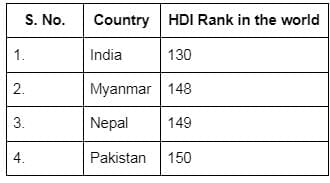
(a) Pakistan
(b) India
(c) Nepal
(d) Myanmar
Ans: (b)
Explanation: India has a higher position in the Human Development Index among the countries listed. Its HDI rank (130) is better than those of Pakistan, Nepal and Myanmar, indicating relatively better combined outcomes in income, life expectancy and education.
Q2: Which one of the following countries has the lowest rank in 'Human Development Index'? (1 Mark)
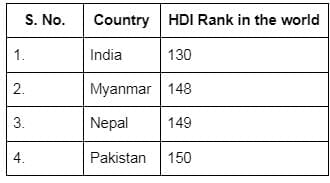
(a) Pakistan
(b) India
(c) Nepal
(d) Myanmar
Ans: (a)
Explanation: Among the countries listed, Pakistan has the lowest HDI position (rank 150). A lower position in the ranking means weaker combined outcomes in health, education and income compared with the other countries named.
Q3: Read the table given below carefully and answer the question that follow :
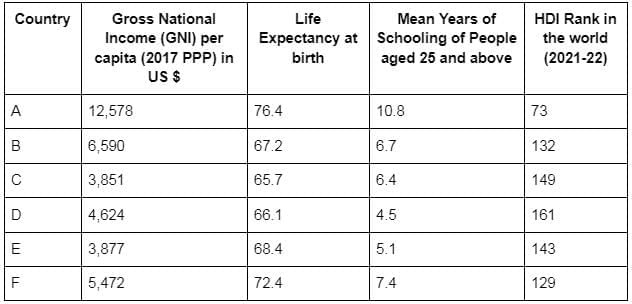
Which one of the following countries has high per capita income, life expectancy at birth, and high rank in Human Development Index? (1 Mark)
Ans: (a)
Explanation: Country A shows the highest per capita income (US $12,578), the highest life expectancy at birth (76.4 years) and the best HDI rank (73) among the entries. These three indicators together make Country A the highest in overall human development in the table.
Q4: Read the table given below carefully and answer the question that follow :
The World Bank's development report is prepared on the basis of which of the following: (1 Mark)
(a) Per Capita Income
(b) Per Capita Production
(c) Gross National Income
(d) Gross Domestic Production
Ans: (a)
Explanation: The World Bank classifies countries in its World Development Report mainly by per capita income (average income per person). This measure helps to group countries by economic standing based on income per head.
Q5: By which organization is the Human Development Report published? (1 Mark)
(a) World Trade Organisation
(b) Amnesty International
(c) United Nations Development Programme
(d) World Health Organisation
Ans: (c)
Explanation: The Human Development Report is prepared and published by the United Nations Development Programme (UNDP). The report compares countries using indicators of health, education and income to assess human development.
Q6: Data related to an imaginary country is given below. Study these data and answer the question that follows :
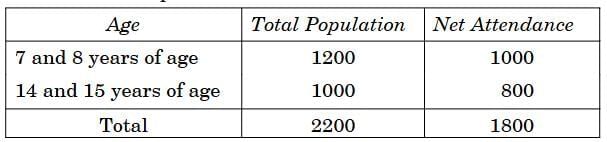
The attendance percentage of this country of the age group of 14 and 15 years is __________ (1 Mark)
(a) 90 percent
(b) 80 percent
(c) 70 percent
(d) 60 percent
Ans: (b)
Explanation: The data given for the age group 14-15 years shows an attendance percentage of 80 per cent. The relevant row/column in the table indicates this directly.
Q7: Choose the correct option to fill in the blank: (1 mark)
The total value of all final goods and services produced within a country in a particular year is called
(a) Per Capita Income
(b) Per Capita Production
(c) Gross National Income
(d) Gross Domestic Product
Ans: (d)
Explanation: The total value of all final goods and services produced within a country in a year is called Gross Domestic Product (GDP) or Gross Domestic Production. It measures the economic output that takes place within the country's borders.
Q8: Read the following developmental goals and choose the correct option of goals related to a student studying in university:
(i) Good opportunities for research.
(ii) Opportunities to pursue higher education abroad.
(iii) Opportunities for independence.
(iv) Opportunities for good employment. (1 Mark)
(a) Only (i), (ii) and (iii) are correct.
(b) Only (ii), (iii) and (iv) are correct.
(c) Only (i), (ii) and (iv) are correct.
(d) Only (i), (iii) and (iv) are correct.
Ans: (c)
Explanation: A university student typically aims for good research opportunities (i), chances to pursue higher studies abroad (ii) and prospects for good employment after completing studies (iv). While independence (iii) is desirable personally, it is not a direct developmental goal related specifically to university education.
Q9: Explain the role of public facilities for quality of life. (2 Marks)
Ans:
- Public facilities such as schools, hospitals, safe water supply, sanitation and public transport directly improve people's quality of life by ensuring basic services that keep people healthy and educated.
- These services are best provided collectively by the government so that everyone, especially the poor, can access them. This leads to reduced disease, higher literacy and better mobility, which together raise living standards.
Q10: Define 'Gross Domestic Product' and explain its importance. (3 Marks)
Ans: Gross Domestic Product (GDP) is the total market value of all final goods and services produced within a country in a particular year. It indicates the country's overall economic output.
Importance:- GDP indicates the economic growth and performance of a country over time.
- It helps in comparing development levels between countries or states by showing relative economic output.
- A rising GDP usually signals higher production, income and employment, which can improve living standards if benefits are widely shared.
Q11: How is income an important factor in assessing the development of a country? Mention the classification done by the World Bank. (5 Marks)
Ans:
- Income matters because it shows people's ability to buy goods and services needed for a better standard of living. Higher income generally improves access to education, healthcare, housing and other basic needs.
- To compare countries, economists use per capita income-total national income divided by total population-to indicate average earnings per person.
- The World Bank classifies countries mainly by per capita income in its World Development Report.
- As per recent classification (2023), countries with per capita income of about US $63,400 or above are classified as high-income, while those with roughly US $2,400 or less are classified as low-income.
- India is placed in the lower-middle-income group with a per capita income near US $10,030 per annum, illustrating how such classification situates countries by average income.
Q12: How has the overuse of underground water created a serious crisis in many parts of India? Explain with examples in the context of sustainable development. (5 Marks)
Ans:
- Overuse of groundwater occurs when extraction (for irrigation, industry or domestic use) exceeds natural replenishment from rainfall and recharge.
- Reports show about 300 districts experiencing falls in water levels of over 4 metres in the past 20 years, indicating shrinking groundwater reserves.
- This is especially severe in agricultural regions such as Punjab and western Uttar Pradesh, where extensive tube-well irrigation has depleted aquifers.
- If current trends continue, nearly 60% of the country could face groundwater overuse in the next 25 years, causing water scarcity, crop losses and threats to livelihoods.
- Such depletion violates the principle of sustainable development, because present use is reducing resources available to future generations; sustainable practices like controlled extraction, rainwater harvesting and efficient irrigation are needed to restore balance.
Q13:Analyse the social and economic goals of development. (5 Marks)
Ans:
- Social goals aim to improve quality of life, dignity and equality. They include freedom, security, respect and equal treatment for all groups-for example, equal opportunities for women and freedom from discrimination.
- Social goals also include access to essential services such as education, healthcare and a clean environment, which are necessary for a decent standard of living.
- Economic goals focus on increasing income, employment and production. People want regular work, better wages and fair prices for goods and services.
- True development combines both sets of goals: economic growth without social well-being is incomplete, and social progress without economic opportunity is fragile.
Q14:Why is the question of the sustainability of development becoming challenging in the present times? Analyse the appropriate reasons. (5 Marks)
Ans:
- Rising consumption and population pressure mean resources are being overused to meet immediate needs.
- Renewable resources (for example, groundwater) are often withdrawn faster than they can be replenished, causing depletion.
- Non-renewable resources such as crude oil are finite and may be exhausted if extraction continues without alternatives.
- Industrialisation and urbanisation have raised pollution, deforestation and environmental degradation, harming ecosystems and human health.
- Because the Earth's resources are limited, unsustainable practices threaten the needs of future generations and make sustainability one of the most serious present-day challenges.
Q15:How can development for one be destructive for another? Explain. (5 Marks)
Ans:
- Development affects people differently because interests and needs vary; what benefits one group can harm another.
- For example, a girl seeking equal freedom and shared household responsibilities may have a development goal that conflicts with traditional family expectations.
- Large projects such as dams may bring electricity and irrigation (benefitting industries and some farmers) but can submerge tribal lands, displacing people and destroying their livelihoods.
- Thus, the same development activity can produce economic gain for some while causing loss, displacement or loss of culture for others.
- Careful planning, compensation and inclusive policies are needed to reduce such conflicts and make development equitable.
Q16:How is income an important factor in assessing the development of a country ? Mention the classification done by the World Bank. (5 Marks)
Ans: Income plays a crucial role in determining development as it reflects people's capacity to fulfill their needs such as food, education, healthcare and housing.
Per capita income is used to measure this, as it gives the average income per person and allows comparison between countries.
The World Bank classifies countries based on per capita income into:
- High-income countries
- Middle-income countries
- Low-income countries
India falls under the lower-middle-income group, showing that while development is progressing, there is still scope for improvement.
Q17: "The consequences of environmental degradation do not respect national and state boundaries." Examine the statement in the context of sustainability of development. (5 Marks)
Ans:
- The statement means environmental harm in one area can affect people far beyond its borders-air and water pollution, climate change and global warming cross national and state lines.
- For example, industrial pollution or deforestation in one country can alter regional rainfall patterns or contribute to higher global temperatures elsewhere.
- Such transboundary impacts make it hard to achieve sustainable development if countries act alone; shared resources like air, rivers and oceans are affected by activities in many places.
- Therefore, global cooperation and collective action-agreements on pollution control, climate mitigation and conservation-are essential to protect the environment for present and future generations.
Q18:"The goals of development may also be contradictory." Examine the statement through examples. (5 Marks)
Ans: Development goals can conflict because progress in one area may harm another; careful balancing is required.
- Economic growth vs Environment: Building large dams (e.g., Sardar Sarovar) increases energy and irrigation but can displace people and damage ecosystems.
- Industrialisation vs Health: Factories raise income but may cause air and water pollution that harms public health (as seen in cities with poor air quality).
- Urbanisation vs Agriculture: City expansion (for example, Bengaluru's growth) can reduce farmland and threaten food security.
- Short-term vs Long-term: Deforestation for immediate profit undermines future climate stability and livelihoods.
- Resolution: Policies such as sustainable urban planning, environmental regulation and investment in renewables can reduce these conflicts.
Q19: Explain the significance and limitations of average income for comparing different countries with examples. (5 Marks)
Ans:
Significance: Average income (per capita income) helps compare the economic standing of countries by showing the typical income per person and is used to classify countries as rich or poor (as done by the World Bank).
Limitations:
- It hides inequalities: two countries with the same average income may have very different income distributions-one may be equitable, the other highly unequal.
- It ignores social indicators such as health, education and equality that matter for people's well-being.
- It does not measure quality of life: higher average income does not automatically mean better health, education or social security for all.
Conclusion: Per capita income is useful but incomplete; it should be supplemented with social indicators to compare development meaningfully.
Q20:Which organisation publishes the Human Development Report and what criteria does it use to compare countries? Examine. (5 Marks)
Ans: The Human Development Report (HDR) is published by the United Nations Development Programme (UNDP).
UNDP uses the Human Development Index (HDI) to compare countries. HDI combines three main criteria:
- Health - measured by life expectancy at birth, which reflects average longevity.
- Education - measured by indicators such as mean years of schooling (for adults) and expected years of schooling (for children).
- Income - measured by Gross National Income (GNI) per capita adjusted for purchasing power, to reflect average living standards.
By combining these indicators, UNDP produces an HDI ranking that gives a broader view of human well-being than income alone. Unlike the World Bank's income-based classification, UNDP's approach emphasises health and education as well as income.
Previous Year Questions 2024
Q1: Study the table given ahead carefully and answer the question that follows. (CBSE 2024) (1 Mark)
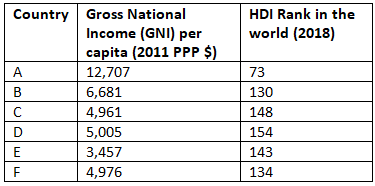
Which of the following country has high Human Development Index Rank in the world?
(a) Country 'A'
(b) Country 'C'
(c) Country 'D'
(d) Country 'E'
Ans: (a)
Explanation: In HDI ranking a lower numerical rank means a higher position (for example, rank 1 is highest). The table shows Country A with a better (lower) HDI rank than Country C (which has rank 148), so Country A is the higher-ranked country among the options.
Q2: Which one of the following definitions is most suitable for the 'Literacy Rate'? (CBSE 2024) (1 Mark)
(a) The literate population at the global level
(b) The proportion of literate population in the seven years and above
(c) The total number of children attending school in a region
(d) The average number of schools in a region
Ans: (b)
Explanation: Literacy rate is defined as the proportion of people aged seven years and above who can read and write. Option (b) correctly captures this definition.
Q3: Which of the following is a key indicator used to measure a country's development? (CBSE 2024) (1 Mark)
(a) Primary Production
(b) Secondary Production
(c) Gross Domestic Product
(d) Net Domestic Product
Ans: (c)
Explanation: Gross Domestic Product (GDP) is a primary indicator of economic activity and is commonly used to measure a country's development because it represents the total value of goods and services produced within the country over a period.
Q4: How does the United Nations Development Program's (UNDP's) developmental criterion differ from the World Bank? Explain. (CBSE 2024) (2 Marks)
Ans: The World Bank mainly measures development through income (per capita income). The UNDP uses a broader approach by combining:
- Health improvements (for example, life expectancy)
- Higher educational attainment (years of schooling)
- Per capita income (as one component)
This broader approach emphasises overall well-being rather than income alone.
 | Get additional INR 200 off today with EDUREV200 coupon. | Avail Offer |
Previous Year Questions 2023
Q5: Assume there are four families in a locality. If the monthly income of each family is ₹10,000, ₹ 20,000, ₹ 30,000 and ₹ 40000 then what is the average income of the locality. Choose the correct option from the following. (2023) (1 Mark)
(a) ₹ 25,000
(b) ₹ 30,000
(c) ₹ 20,000
(d) ₹10,000
Ans: (a)
Explanation: Add the incomes: ₹10,000 + ₹20,000 + ₹30,000 + ₹40,000 = ₹1,00,000. Divide by 4 families: ₹1,00,000 ÷ 4 = ₹25,000. So option (a) is correct.
Q6: "Different persons can have different developmental goals." (CBSE 2023) (2 Marks)
OR
How do different people have different developmental goals? Explain with examples. (CBSE 2019, 14) (2 Marks)
Ans: People have different developmental goals because they come from different backgrounds and have different needs. For example, a farmer may prioritise better irrigation, while an unemployed youth may prioritise job opportunities. These differing needs produce different development goals.
Q7: Which of the following countries has the highest 'Life Expectancy' at the birth'? (2023) (1 Mark)
(a) Nepal
(b) Bangladesh
(c) India
(d) Pakistan
Ans: (b)
Explanation: Life expectancy at birth is the average number of years a newborn is expected to live. Among the listed countries, Bangladesh records the highest life expectancy due to improvements in healthcare and living conditions, making option (b) correct.
Q8: Which of the following countries has a better rank it the Human Development Index? (2023) (1 Mark)
(a) Afghanistan
(b) Myanmar
(c) India
(d) Nepal
Ans: (c)
Explanation: Human Development Index (HDI) combines indicators of health, education and income. India has a comparatively better HDI ranking than Afghanistan, Myanmar and Nepal, so option (c) is correct.
Q9: Read the following data and answer the question that follow:
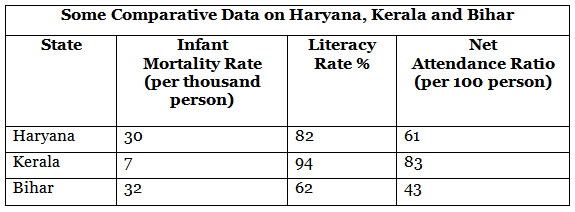
How much is the Net Absence Ratio of Haryana ? Choose the appropriate option from the following: (CBSE 2023) (1 Mark)
(a) 39
(b) 27
(c) 38
(d) 18
Ans: (a)
Explanation: Net Absence Ratio = 100 - Net Attendance Ratio. For Haryana, Net Attendance Ratio is 61, so Net Absence Ratio = 100 - 61 = 39. Thus option (a) is correct.
Q10: Read the following statements about Human Development and choose the correct option:
(I) It is the composite Index prepared by United Nations Development Programme (UNDP).
(II) Parameters to measure it are Longevity, Literacy and Per Capita Income.
(III) Countries are ranked according to Developed and Low Developing countries.
(IV) World Bank also prepares report of Human Development on the basis of Quality of Life. (CBSE 2023) (1 Mark)
(a) I and II
(b) II and III
(c) I and III
(d) II and IV
Ans: (a)
Explanation: Statements I and II are correct: HDI is a composite index by UNDP and uses longevity (life expectancy), literacy/education and per capita income. Statement III is a misrepresentation of how rankings work, and statement IV is incorrect about the World Bank's role here.
Q11: The question of sustainability of development raises many fundamentally new issues about the nature and process of development'. Explain it with examples. (CBSE 2023) (3 Marks)
Ans: The sustainability question emphasises that present development must not harm future generations. For example:
- Sustainable development aims to protect natural resources while allowing growth; it seeks a stable relationship between human activity and nature.
- Non-renewable resources such as crude oil are exhaustible; reckless extraction risks future supply.
- Renewable resources like groundwater can become effectively exhausted if used faster than they recharge, showing the need for careful management.
Q12: Which one of the following is a developmental goal of the factory workers? (CBSE 2023) (1 Mark)
(a) Better wages
(b) Better technology
(c) More hours of work
(d) More labour work
Ans: (a)
Explanation: Factory workers commonly prioritise better wages, as higher pay directly improves their living standards and economic security. Other options either refer to employer interests (better technology) or are not desirable (more hours).
Previous Year Questions 2022
Q13: Suppose there are four families in your locality, the average per capita income of whom is 10,000. If the income of three families is 6,000; 8,000 and 14,000 respectively, what would be the income of the fourth family? (2022)
(a) 5,000
(b) 10,000
(c) 12,000
(d) 15,000
Ans: (c)
Sol: Suppose the income of fourth family is x. According to question.
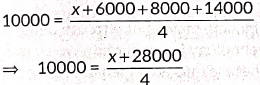
⇒ x + 28000 = 40000
⇒ x = ₹12000
Also read: Short Answer Questions: Development |
Previous Year Questions 2021
Q14: What is development? Why do different people have different development goals? Explain with four examples. (2021 C)
Ans: Development refers to the process of improving people's quality of life by using resources, technology and institutions for economic growth and human welfare.
Reasons and examples why different people have different goals:
- Different needs: A farmer may prioritise improved irrigation; an unemployed youth may seek jobs.
- Different aspirations: A girl from a wealthy family may aim for higher education and independence.
- Different circumstances: Landless labourers may want more work days and better wages.
- Conflicting interests: Industrial growth may benefit factory owners but displace local communities.
Q15: In what respect is the criterion used by the UNDP different from that of the World Bank? What are the limitations of the criterion used by the World Bank? (2021)
Ans: The World Bank uses per capita income as the primary measure of development. This is limited because it does not show how people actually live.
The UNDP uses the Human Development Index (HDI), which includes:
- Per capita income
- Life expectancy (health)
- Literacy and schooling (education)
Limitations of World Bank's income criterion include ignoring health and education, hiding inequalities and failing to capture quality of life.
Q16: Suppose there are four families in your locality, the average per capita income of whom is 10,000. If the income of three families is 6,000, 8,000 and 14,000 respectively, what would be the income of the fourth family?
(a) 5,000
(b) 10,000
(c) 12,000
(d) 15,000 (CBSE Term-1 2021)
Ans: (c)
Sol: Total income = 10,000 × 4 = ₹40,000. Sum of three incomes = ₹28,000. Fourth family income = 40,000 - 28,000 = ₹12,000.
Q17: There are two statements marked as Assertion (A) and Reason (R). Mark your answer as per the codes provided below:
(a) Both (A) and (R) are true and (R) is the correct explanation of (A).
(b) Both (A) and (R) are true but (R) is not the correct explanation of (A).
(c) (A) is correct but (R) is wrong.
(d) (A) is wrong but (R) is correct.
Assertion (A) : Kerala has low Infant Mortality Rate.
Reason (R) : Kerala has adequate provision of basic health and education facilities. (CBSE Term-1 2021)
Ans: (a)
Explanation:
(i) Assertion: Kerala has a low infant mortality rate - True.
(ii) Reason: Kerala has good basic health and education facilities - True.
(iii) Justification: The adequate provision of healthcare and education in Kerala contributes directly to lower infant mortality, so (R) correctly explains (A).
Previous Year Questions 2020
Q18: Choose the incorrect option from column A and column B. (2020)
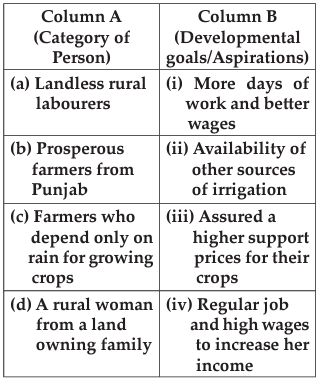
Ans: (c)
Sol: The incorrect pairing is that farmers who depend on rain for growing crops are assured a higher support price; dependence on rain does not guarantee higher support prices.
Q19: What is development? Why do different people have different development goals? Explain with four examples. (2020 C)
Ans: Development refers to the process of improving people's quality of life by using resources, technology and institutions for economic growth and human welfare.
Four characteristics/examples:
- Different goals: People from varied backgrounds have different priorities.
- Subjective nature: What is development for one may not be for another.
- Mix of goals: Individuals often want a combination of economic and social improvements.
- Conflicting notions: Goals may conflict-for example, industrial growth may harm some local communities.
Q20: "Different people have different goals of development". Explain the statement. (2020)
Ans: Different people set different development goals because of varying backgrounds, aspirations and circumstances. For example:
- A farmer may seek better irrigation facilities.
- An unemployed youth may seek steady employment.
- A student may seek higher education opportunities.
- Family circumstances can force changes in goals, such as shifting from study to work.
Q21: Define the term per capita income. (CBSE 2020)
Ans: Per capita income is the average income earned per person in an area in a year. It is calculated by dividing the total income of the area by its population.
Q22: Define the term literacy rate. (2020)
Ans: The literacy rate is the percentage of people aged seven years and above who can read and write. It is a key indicator of educational attainment in a population.
Q23: In comparison to Kerala, which state has the highest infant mortality rate? (2020)
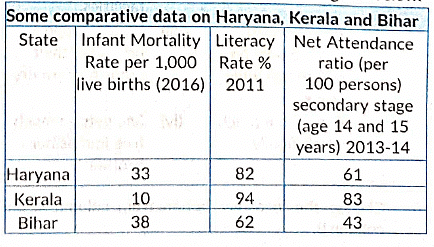
Ans: Bihar has the highest infant mortality rate compared with Kerala, according to the data provided.
Q24: "Suppose the average income of a country is not being increased over time but the records of the National Income show a rise". What does this situation signify? (2020)
Ans:
When the average income of a country remains unchanged over time, yet the National Income records show an increase, it indicates a situation of unequal income distribution.
- This means that while the total income of the country may be rising, it is not benefiting everyone equally.
- A small number of individuals may be accumulating wealth, while the majority see little to no improvement in their income.
- This disparity can lead to social and economic issues within the country.
Q25: Fill in the blank: Human Development Index (HDI) level in India can be improved through _____. (2020)
Ans: (i) Increasing educational levels of the people.
(ii) Improving health status.
(iii) Raising per capita income.
Q26: Suggest any three ways to maintain Body Mass Index. (2020)
Ans: Three ways to maintain a healthy Body Mass Index are:
- Regular physical activity (about 60-90 minutes on most days).
- Drink enough water and follow a balanced diet.
- Avoid excessive consumption of fast and oily foods.
Q27: Why is the issue of sustainability important for development? Explain. (CBSE 2020)
Ans: Sustainability matters because unchecked use of resources today can deprive future generations of the same resources. For example, over-extraction of groundwater or over-use of fossil fuels can lead to exhaustion of these resources. Therefore, development must balance present needs with the long-term availability of resources so future generations can meet their needs.
Q28: "Sustainability of development is a crucial aspect in present times". Support the statement with examples. (2020)
Ans: It is felt that the economic growth and industrialisation have led to reckless exploitation of natural resources. Sustainability promotes a rational use of natural resources.
(i) Currently, reckless exploitation of non-renewable natural resources is going on. Since the stock of natural resources like oil and minerals is limited, development should not take place at the cost of these scare natural resources as they are not renewable in the near future.
(ii) Ground water is an example of renewable resource. But if we use more than what is replenished by nature, then we would be overusing this resource.
(iii) Once the non-renewable resources would be exhausted, we would not be able to use them in future. So, using the resources judiciously will help in maintaining the sustainability of development of our ecosystem.
(iv) Economic development is a continuous process. Resources are to be used in such a way that they are not exploited. At the same time, development should not harm the environment.
Q29: Suggest any one way to create employment in semi-rural areas. (CBSE 2020)
Ans: Establishing food-processing units and capacity building in semi-rural areas can create local employment by adding value to agricultural produce and offering new jobs.
Q30: Suggest any three ways to improve public facilities in India. (CBSE 2020)
Ans: Three ways to improve public facilities are:
- Ensure accessible and affordable education for all by opening more government schools and reducing fees up to elementary level.
- Reform the Public Distribution System to reduce corruption and monitor quality and reach of food grains.
- Improve health services by making basic care free or affordable for children, senior citizens and disadvantaged groups.
Previous Year Questions 2019
Q31:What may be a goal of landless rural labourers regarding their income? (Delhi 2019)
Ans: A landless rural labourer's income goal may be to secure more days of work and obtain better wages to improve household income and living standards.
Q32: What may be a goal of a prosperous farmer of Punjab? (Delhi 2019)
Ans: Goals of a prosperous Punjabi farmer may include:
- Improving irrigation facilities for higher yields.
- Providing children with better education.
- Adopting high-yield crop varieties and modern inputs to increase production.
Q33: What may be a developmental goal of urban unemployed youth? (CBSE 2019, 12)
Ans: Developmental goals for urban unemployed youth may include securing regular employment with a good salary, finding jobs suited to their qualifications, and achieving career growth.
Q34: "Consequences of environmental degradation do not respect national or state boundaries". Support the statement with an example. (2019)
Ans: Environmental problems such as global warming, acid rain and cross-border air or water pollution affect multiple countries or states, not just the place where the damage began. For example, greenhouse gas emissions in one country contribute to climate change globally, requiring international cooperation.
Q35: What may be one of the developmental goals of a girl who belongs to a rich urban family? (CBSE 2019, 14, 11)
Ans: A possible goal for a girl from a wealthy urban family is to have the same freedom as her brother to pursue higher education, career opportunities and personal achievements.
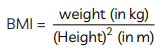
Q36: Mention the formula to calculate the BMI (Body Mass Index). (CBSE 2019)
Ans: BMI = weight in kg ÷ (height in metres)2. For example, weigh (kg) divided by square of height (m).
 | Attention! Sale expiring soon, act now & get EduRev Infinity at 40% off! | Claim Offer |
Previous Year Questions 2017
Q37:Why is average income considered as an important criterion for development? Give one reason. (2017)
Ans: Average income reflects the common economic well-being by showing total national income divided by population; if average income is adequate to meet basic needs, it suggests a higher level of development.
Q38: Why does Kerala have a low infant mortality rate? (2017)
Ans: Kerala has a low infant mortality rate because it has invested strongly in education and health services, resulting in better maternal and child care and overall public health outcomes.
Q39: On the basis of which three indicators of HDI 2004 Sri Lanka has a better rank than India? (2017)
Ans: Sri Lanka ranked better than India on these three HDI indicators:
- Life expectancy (health)
- Gross enrolment ratio (education)
- Per capita income (income)
Q40: What is the meaning of development? Explain the two aspects of development. (2017)
Ans: Development refers to the process of improving people's quality of life by using resources, technology and institutions for economic growth and human welfare. Two important aspects are:
- Different people have different developmental goals based on their needs and circumstances.
- What counts as development for one person may not be for another and may even be harmful for some groups; thus development must consider multiple dimensions.
Q41: What is average income? What is its importance? Mention its limitations related to development. (2017)
Ans: Average income (per capita income) is total national income divided by population. It helps classify countries and gives an indication of economic well-being.
Limitations:
- Inflation can distort per capita income if price rises account for income growth.
- It hides income distribution; rising national income may benefit only a few.
- It ignores non-market goods and non-monetary contributions important to welfare.
- Population growth may offset national income gains, reducing per capita availability.
Q42: What is the main criterion used by the World Bank in classifying different countries? Describe its limitations. (2017)
Ans: The World Bank primarily uses per capita income to classify countries.
Limitations:
- It focuses narrowly on income and ignores social aspects like health and education.
- It can hide internal inequalities where a small rich group raises the average.
- Arbitrary income thresholds may not capture real development differences.
Q43: How is it that the average person in Punjab has more income than the average person in Kerala but it lags behind in many other crucial areas? Explain. (2017)
Ans: Higher average income in Punjab does not mean better outcomes in health, education or social welfare. Kerala has invested more in education and health, producing better literacy, life expectancy and overall human development despite lower average income. Thus income alone does not capture all aspects of development.
Previous Year Questions 2016
Q44: 'For development, people look at a mix of goals\". Support the statement with three suitable example. (2016)
Ans: People consider a mix of goals when thinking of development. Examples:
- Someone may want higher education and also a secure job.
- A farming family may want better irrigation and improved schools for children.
- Workers may want both higher wages and safer working conditions.
Q45: Explain the factors on which the quality of life depends. (CBSE 2016)
Ans: Quality of life depends on:
- Money and material comforts.
- Presence of family, friends and social support.
- Good working conditions.
- Opportunities to learn and contribute.
- Self-respect and social standing.
- Safety and security in daily life.
Q46: Explain the three components of the Human Development Index. (2016)
Ans: The HDI is based on three components:
- Life expectancy (health) which shows longevity.
- Education measured by years of schooling (mean and expected years).
- Per capita income which indicates average living standards.
Q47: Which three efforts should be made by any country to improve its HDI? (2016)
Ans: To improve HDI, a country should:
- Invest in education to raise literacy and years of schooling.
- Improve healthcare to raise life expectancy and reduce mortality.
- Promote a cleaner environment and social services to enhance welfare.
Q48: What is sustainable development? Why is the issue of sustainability important for development? Explain. (2016)
Ans: Sustainable economic development means development should take place without damaging the environment, and development in the present should not compromise with the needs of the future generations. It is important because resources are limited; economic progress that destroys the environment or exhausts resources will leave future generations worse off. Hence, development must proceed with resource conservation and environmental protection.
Q49: What is national development? What aspects are covered under national development? (2016)
Ans: National development means the development of a country in which the welfare and well-being of all people are considered, not just an increase in income. It includes equal opportunities, freedom, security, respect and a better quality of life for everyone. Aspects include:
- Raising economic awareness and income.
- Increasing agricultural output.
- Poverty reduction and rural development.
- Managing urban growth and promoting gender parity.
- Conflict resolution and social stability.
Q50: Explain the importance of sustainable development by giving the example of groundwater. (CBSE 2016)
Ans:
Ans: Groundwater is an important natural resource that exemplifies the importance of sustainable development.
Here's how:
- Groundwater is a renewable resource that plays a crucial role in meeting the water needs of various sectors, including agriculture, industry, and domestic use. However, excessive extraction and overuse of groundwater can lead to its depletion and long-term negative consequences.
- Sustainable development emphasizes the responsible and judicious use of resources, including groundwater. By adopting sustainable practices, such as efficient irrigation techniques, rainwater harvesting, and recharging groundwater sources, we can ensure the long-term availability of groundwater.
- For example, in areas where groundwater is the primary source of irrigation for agriculture, sustainable practices like drip irrigation and precision farming can help reduce water wastage and improve water-use efficiency. This ensures that the available groundwater resources are used optimally without depleting them.
- Furthermore, sustainable development promotes the protection of groundwater quality. Unregulated disposal of industrial waste, improper sanitation systems, and excessive use of chemical fertilizers and pesticides can contaminate groundwater, making it unfit for human consumption and harming ecosystems. Sustainable development focuses on implementing proper waste management systems, promoting organic farming practices, and protecting water sources from pollution, thus safeguarding the quality of groundwater.
- By prioritizing sustainable development practices, we can ensure the sustainable use and management of groundwater resources, meeting the present needs without compromising the ability of future generations to meet their own needs.
Also read: Short Answer Questions: Development |
Previous Year Questions 2015
Q51: What is the development goal of rural people of India as per your viewpoint? (CBSE 2015)
Ans: The development goals of rural people typically include better access to food and resources, improved transport and communication facilities, and better basic services such as schools and health centres.
Q52: What does Sustainability of development mean? How can sustainable development be achieved? (CBSE 2015)
Ans: Sustainability of development means pursuing growth without damaging the environment or exhausting resources needed by future generations. It can be achieved by:
- Minimising environmental damage through cleaner technologies.
- Using resources judiciously and conserving non-renewable stocks.
- Managing renewable resources so they are not overused (for example, groundwater recharge).
Previous Year Questions 2012
Q53: "The future generation may not have sufficient resources as compared to the present generation." Explain the statement by giving suitable examples. (CBSE 2012)
Ans: Future generations may inherit fewer resources if current use is unsustainable. Examples:
- Groundwater is being overexploited in many areas and may become scarce.
- Even some renewable sources can be effectively exhausted if mismanaged.
- Many resources have limited stocks and overuse today reduces availability tomorrow.