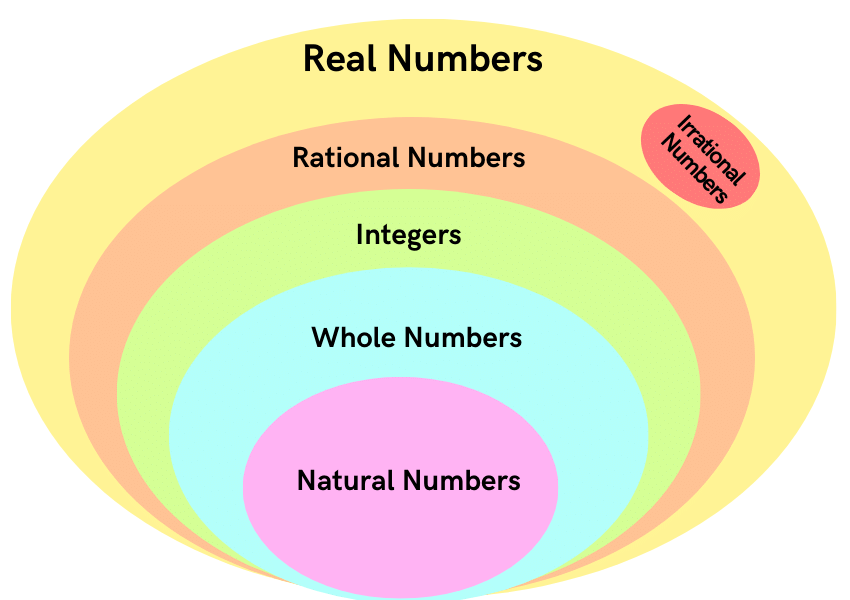
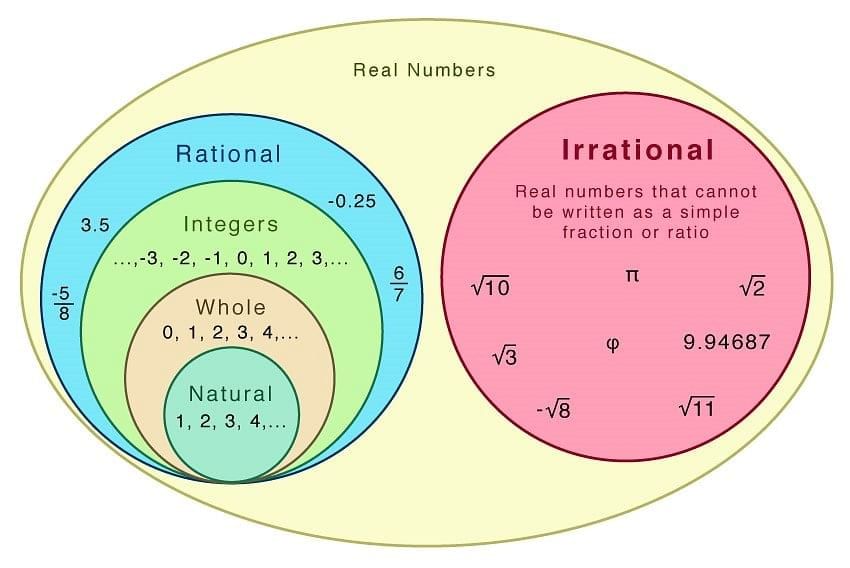
Real numbers are all the numbers that can be found on the number line. This includes both rational numbers (like 7, -3, 0.5, and 4/3) and irrational numbers (like √2) . They encompass integers, fractions, and decimals, representing a continuous, unbroken set of values.
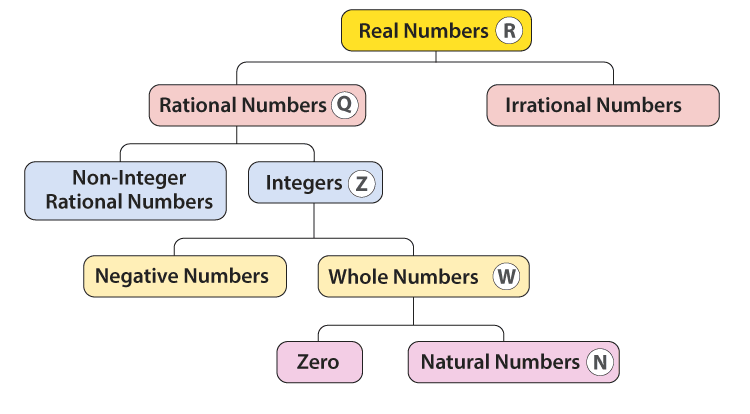
Classification of Real Numbers
- Natural Numbers: Natural Numbers are a set of counting numbers. They are denoted by N.N = {1, 2, 3, 4..........∞}
- Whole Numbers: Whole numbers are a set of natural numbers plus zero.W = {0, 1, 2, 3 ......... ∞}
- Integers: Integers is a set of whole numbers and negative of all natural numbers.Z = { -3, -2, -1, 0, 1, 2, 3}
- Rational Numbers: All the numbers that can be written in the p/q form where p and q are integers and q ≠ 0 are called rational numbers.E.g. 8/11, -3/17
- Irrational Numbers: All the numbers that cannot be written in the p/q form are called irrational numbers. All the non-terminating and non-repeating decimal numbers are irrational numbers.E.g. √5, √3, √5 + √3, π
Fundamental Theorem of Arithmetic
To understand the fundamental theorem of Arithmetic, first, it is important to know what are composite numbers and prime numbers.
Composite Number
Prime Number
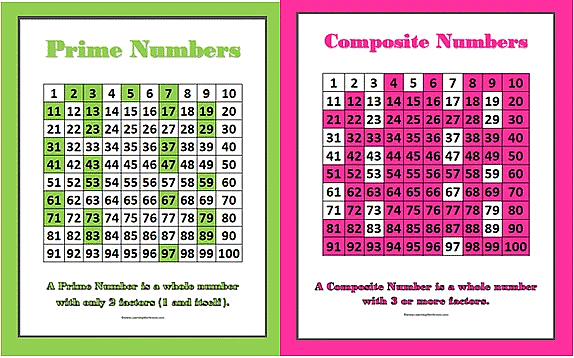 Prime and Composite Numbers
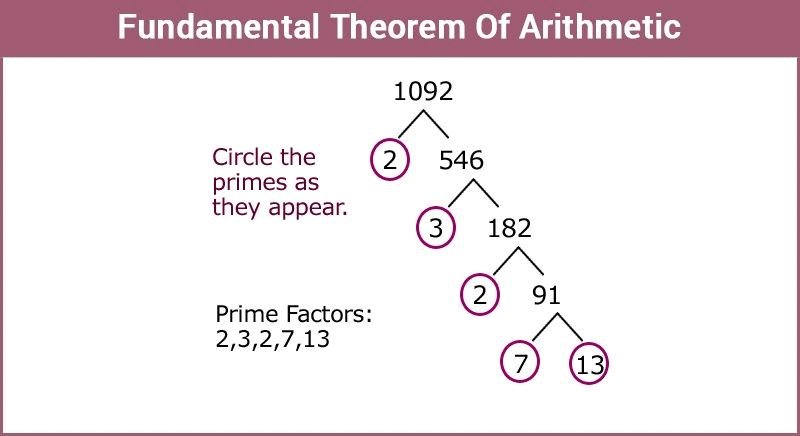
Theorem: Fundamental Theorem of Arithmetic states that every composite number can be expressed as a product of primes, and this factorization is unique, apart from the order in which the prime factors occur.
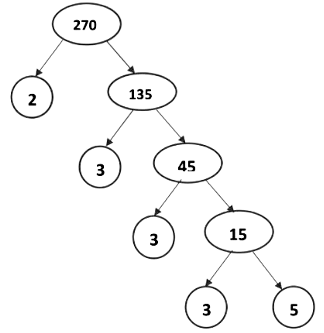
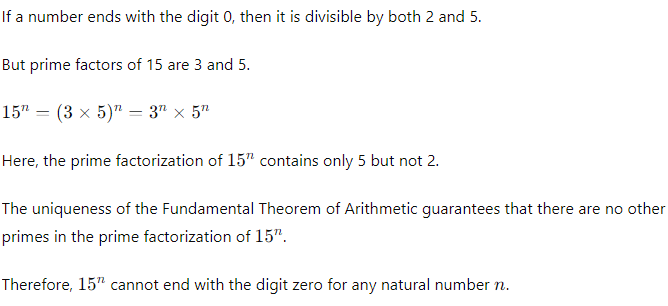
Example 1: Check whether 15n can end with the digit zero for any natural number n.
Sol:
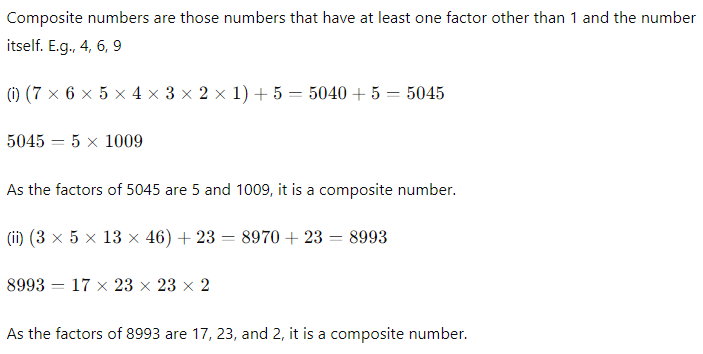
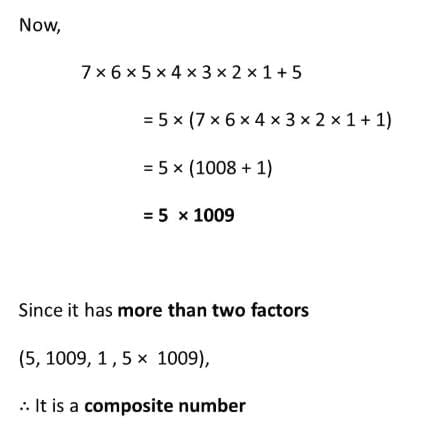
Example 2: Explain, why (7 × 6 × 5 × 4 × 3 × 2 × 1) + 5 and (3 × 5 × 13 × 46) + 23 is a composite number?
Sol:
HCF and LCM by Prime Factorisation Method
In this method, we first express the given numbers as a product of prime factors separately. Then, HCF is the product of the smaller power of each common prime factor in the numbers, and LCM is the product of the greatest power of each prime factor involved in the numbers.
For any two positive integers a and b,
HCF (a, b) × LCM (a, b) = a × b
Sol:
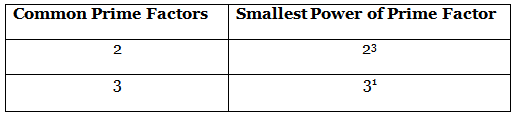
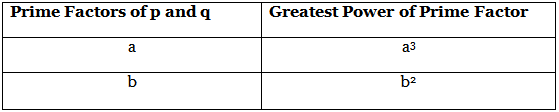
Example 4: If two positive integers p and q can be expressed as p = ab2 and q = a3b, where a, b are prime numbers, find the LCM (p, q).
Sol:
Example 5: Write the HCF and LCM of the smallest odd composite number and the smallest odd prime number.
Sol:
Example 6: If HCF (253,440) = 11 and LCM (253,440)= 253 × R. Find the value of R.
Sol:
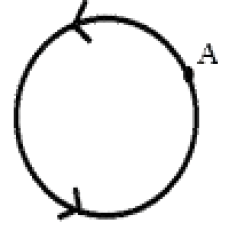
Example 7: Ravi and Shikha drive around a circular sports field. Ravi takes 16 min to complete one round, while Shikha completes the round in 20 min. If both start at the same point, at the same time, and go in the same direction, then how much time will they meet at the starting point?
Sol:
Try yourself: According to the Fundamental Theorem of Arithmetic, which of the following statements is true?
Revisiting Irrational Numbers
Irrational numbers are those numbers that cannot be written in the form p/q, where p and q are integers and q ≠0. E.g.,√2, √3, √15
The square roots of all the numbers do not give an irrational number.
Theorem : If a prime number p divides a2, then p divides a, where a is a positive integer.
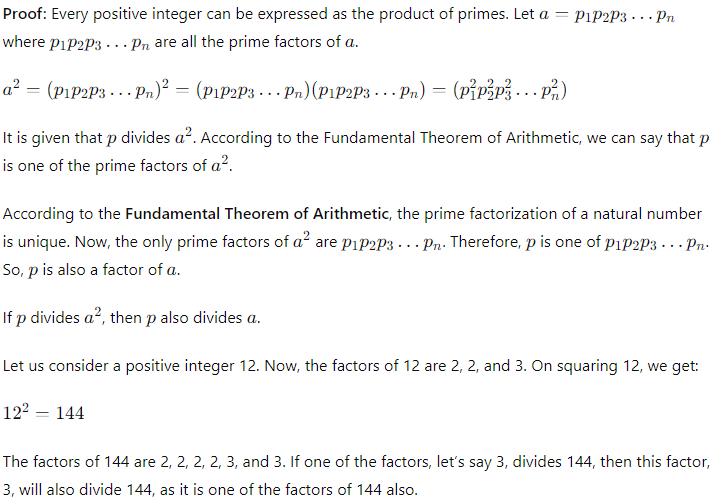
Theorem: Prove that √2 is an irrational number.
Sol:
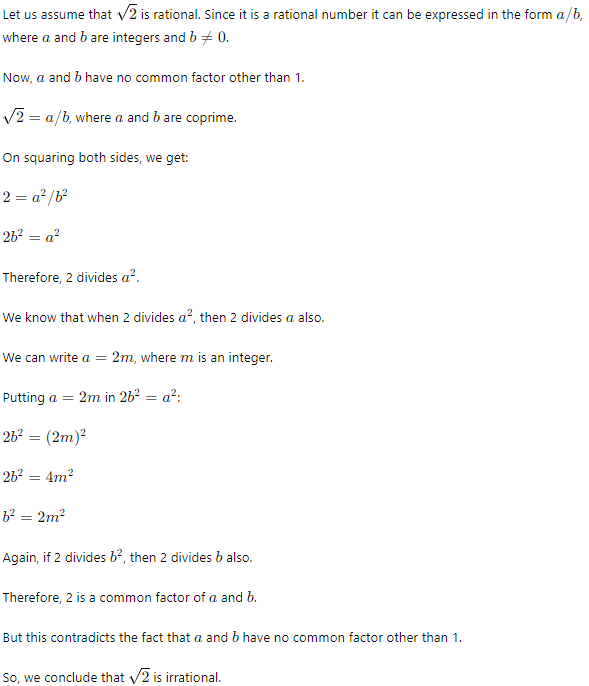
Example 8: Show that 3√2 is an irrational number.
Sol:
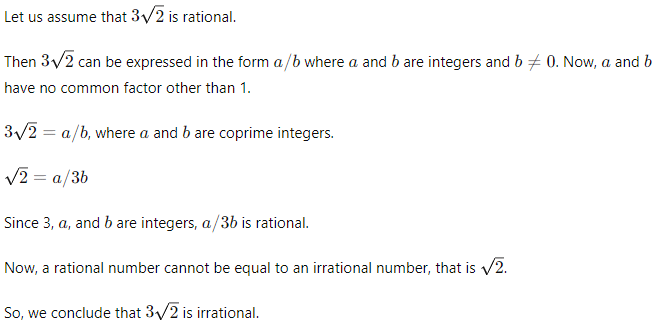
Example 9: Show that 5 - √3 is irrational.
Sol:
Important Definitions
1. Real Numbers
- Real numbers constitute the union of all rational and irrational numbers.
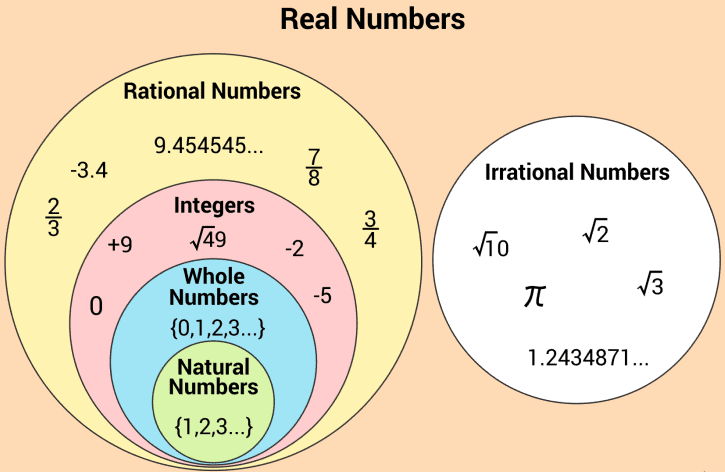
- In general, all the arithmetic operations can be performed on these numbers and they can be represented on the number line, also.
2. Fundamental Theorem of Arithmetic
- Every composite number can be factorized as a product of primes and this factorization is unique, apart from the order in which the prime factors occur.
- Example: 54=2×3×3×3
- Therefore, 54 is represented as a product of prime factors (One 2 and three 3s) ignoring the arrangement of the factors.
- Also, the number 120 can be factorized as 2 × 2 × 2 × 3 × 5. The prime factors are 2, 2, 2, 3, and 5. The order of the factors doesn't matter, as the Fundamental Theorem of Arithmetic guarantees a unique factorization regardless of the arrangement of the prime factors.
Example 1: What is the HCF of 36 and 48 using prime factorization?Solution: To find the HCF using prime factorization, follow these steps:1. Find the prime factors of each number.Prime factors of 36: 2 × 2 × 3 × 3 = (22 × 32)Prime factors of 48: 2 × 2 × 2 × 2 × 3 = (24 × 3)2. Find the common prime factors.Common prime factors: 2 × 2 × 3 = (22 × 3)3. Multiply the common prime factors to get the HCF.HCF = 2 × 2 × 3 = 12So, the HCF of 36 and 48 using prime factorization is 12.
Example 2 : Consider the number 4n, where n is a natural number. Is there any value of n for which 4n ends with the digit zero? Justify your answer.Solution:If 4n, for any n, were to end with the digit zero, it would need to be divisible by 10. For a number to be divisible by 10, its prime factorization must include both the primes 2 and 5.The prime factorization of 4n is:
4n=(2)2n
This shows that the only prime factor in 4n is 2. Since there is no 5 in the factorization, 4n cannot be divisible by 10.
Thus, by the Fundamental Theorem of Arithmetic, which ensures the uniqueness of prime factorization, there are no natural numbers n for which 4n ends with the digit zero.
3. Rational Numbers
The decimal expansion of every rational number is either terminating or non-terminating repeating.
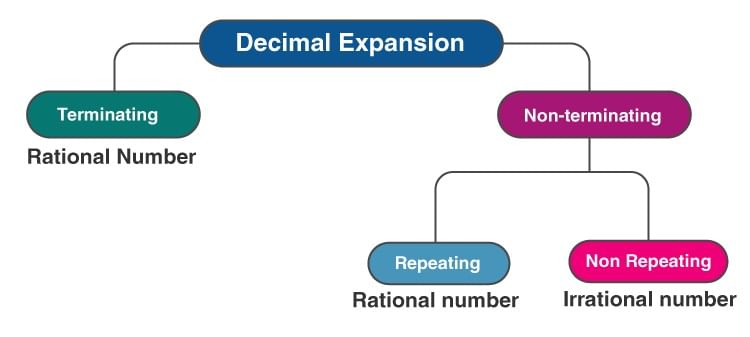
- Terminating Decimal Representation: Let x be a rational number with a terminating decimal representation. Then we can express x as p/q where p and q are coprime, and the prime factorization of q is of the form 2n 5m, where n, m are some non-negative integers.
- Non-terminating Decimal Representation: The rational number p/q will have a non-terminating repeating(recurring) decimal representation if, in standard form, the prime factorization of q is not of form 2n 5m, where n, m is some non-negative integers.
4. Irrational Number
- A number is irrational if and only if, its decimal representation is non-terminating and non-repeating (non-recurring).OR
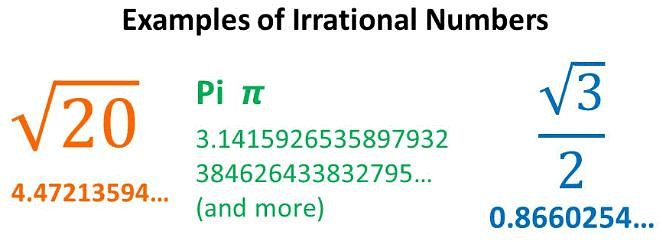
- A number that cannot be expressed in the form of p/q, q ≠ 0 and p, q ∈ I, will be an irrational number. The set of irrational numbers is generally denoted by S.
Example 3: Prove that 3 + 2√5 is irrational.
Solution: Let 3 + 2√5 be a rational number.
Then the co-primes x and y of the given rational number where (y ≠ 0) is such that:
3 + 2√5 = x/y
Rearranging, we get,
2√5 = (x/y) - 3
√5 = 1/2[(x/y) - 3]
Since x and y are integers, thus, 1/2[(x/y) - 3] is a rational number.
Therefore, √5 is also a rational number. But this confronts the fact that √5 is irrational.
Thus, our assumption that 3 + 2√5 is a rational number is wrong.
Hence, 3 + 2√5 is irrational.
Try yourself: Find out the decimal expansion of 13/125.
We are asked to determine whether 13/125 has a terminating decimal expansion without actually dividing.
A rational number p/q will have a terminating decimal expansion if:
p and q are co-prime, and
the prime factorisation of q has only 2s and/or 5s (i.e., q is of the form 2ⁿ × 5ᵐ)
Since the denominator has only the prime factor 5, it satisfies the condition.
5. Prime Number
A prime number is a natural number greater than 1 that has exactly two distinct positive divisors: 1 and the number itself.
In other words, a prime number cannot be formed by multiplying two smaller natural numbers. The first few prime numbers are 2, 3, 5, 7, 11, 13, 17, and so on.
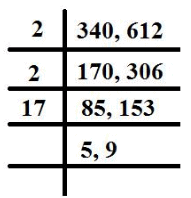
Example 4: Express each number as a product of its prime factors:(i) 140(ii) 156Solution: (i) 140Using the division of a number by prime numbers method, we can get the product of prime factors of 140.Therefore, 140 = 2 × 2 × 5 × 7 × 1 = 22 × 5 × 7(ii) 156Using the division of a number by prime numbers method, we can get the product of prime factors of 156.Hence, 156 = 2 × 2 × 13 × 3 = 22 × 13 × 3
Important Formulas with Examples
LCM & HCF of Two Numbers


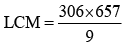
Example 5: Given that HCF (306, 657) = 9, find LCM (306, 657).
Solution: As we know that,
HCF × LCM = Product of the two given numbers
So, 9 × LCM = 306 × 657
LCM = (306 × 657)/9
LCM = 22,338
Therefore, LCM (306,657) = 22,338
Worksheet:
Rational + Irrational Numbers = Real Numbers
True and False
Very Short Questions
Q.3. Find the prime factorization of 1152
Q4: Show that the product of two numbers 60 and 84 is equal to the product of their HCF and LCM
Q5: If p and q are two coprime numbers, then find the HCF and LCM of p and q.
Short Questions
Q6: Given that H.C.F. (306, 657) = 9, find L.C.M. (306, 657)
Q7: The H.C.F. and L.C.M. of two numbers are 12 and 240 respectively. If one of these numbers is 48; find the other numbers.
Long Questions
Q8: In a school, the duration of a period in junior section is 40 minutes and in senior section is 1 hour: If the first bell for each section ring at 9:00 a.m., when will the two bells ring together again?
Q9: The HCF of 408 and 1032 is expressible in the form 1032 m - 2040. Find the value of m. Also, find the LCM of 408 and 1032.
Q1: Use Euclid's division lemma to show that the square of any positive integer is of the form 3m or 3m + 1.
Q2: Prove that √5 is irrational.
Q3: State and prove the Fundamental Theorem of Arithmetic.
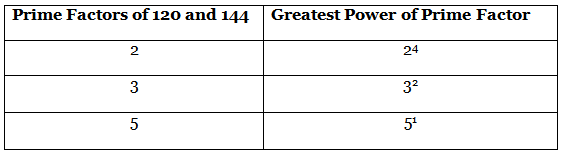
Q4: Find the HCF and LCM of 120 and 144 using prime factorisation.
Q5: Show that the product of two consecutive positive integers is divisible by 2.
Q6: Find a rational number between √2 and √3.
Q7: Show that 6n cannot end with digit 0 for any natural number n.
Q8: Determine whether the decimal expansion of 43/(2⁴ × 5³) is terminating.
Q9: Find HCF of 52 and 117 using Euclid's algorithm.
Q10: If HCF of two numbers is 12 and their product is 1800, find their LCM.
Q11: Show that √2 + √3 is irrational.
Q12: Prove that there are infinitely many prime numbers.
Q13: Express 0.375 as a rational number.
Q14: Find the LCM and HCF of 98 and 28.
Q15: Check whether 7ⁿ can end with digit 0 for any natural number n.
Short Answer Questions
Q1: Prove that √3 is irrational.
Let √3 be rational in the simplest form of P/q.i.e., p and q are integers having no common factor other than 1 and q ≠ 0.Now, √3 = p/qSquaring both sides, we have⇒ (√3)2 = (p/q)2⇒ 3 = p2/q2⇒ 3q2 = p2 ............(1)Since 3q2 is divisible by 3∴ p2 is also divisible by 3⇒ p is divisible by 3 ..........(2)Let p = 3c for some integer 'c'.Substituting p = 3c in (1), we have:⇒ 3q2 = (3c)2⇒ 3q2 = 9c2⇒ q2 = 3c23c2 is divisible by 3∴ q2 is divisible by 3⇒ q is divisible by 3 ...(3)From (2) and (3)3 is a common factor of 'p' and 'q'. But this contradicts our assumption that p and q are having no common factor other than 1.∴ Our assumption that √3 is rational is wrong.Thus, √3 is an irrational.
Q2: If 'p' is prime, prove that √p is irrational.
Let √p be rational in the simplest form a/b, where p is prime.∴ a and b are integers having no common factor other than 1 and b ≠ 0.⇒ Now, √p = a/b⇒ Squaring both sides, we have⇒ pb2 = a2 ...(1)⇒ Since pb2 is divisible by p, a2 is also divisible by p.⇒ a is also divisible by p ...(2)Let a = pc for some integer c.⇒ Substituting a = pc in (1), we havepb2 = (pc)2⇒ pb2 = p2c2⇒ b2 = pc2pc2 is divisible by p,∴ b2 is divisible by p⇒ b is divisible by p ...(3)From (2) and (3),⇒ p is a common factor of 'a' and 'b'. But this contradicts our assumption that a and b are co-prime.∴ Our assumption that √p is rational is wrong. Thus, √p is irrational if p is prime.

Q3: Find the HCF of 18 and 24 using prime factorisation.
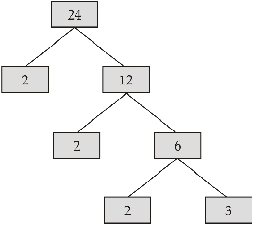
Using factor tree method, we have:∴ 18 = 2 × 3 × 3 = 2 × 3224 = 2 × 2 × 2 × 3 = 23 × 3HCF = Product of common prime factors with lowest powers.⇒ HCF (18, 24) = 3 × 2 = 6
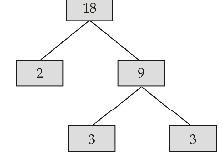


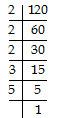 ∴ 10 = 2 × 5 = 21 × 5130 = 2 × 3 × 5 = 21 × 31 × 51120 = 2 × 2 × 2 × 3 × 5 = 23 × 31 × 51LCM = Product of each prime factor with highest powers⇒ LCM of 10, 30 and 120 = 23 × 3 × 5 = 120.
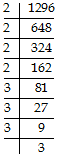
Q5: Find the LCM and HCF of 1296 and 5040 by prime factorisation method.
and
∴ 5040 = 2 × 2 × 2 × 2 × 3 × 3 × 5 × 7= 24 × 32 × 5 × 7 and⇒ 1296 = 2 × 2 × 2 × 2 × 3 × 3 × 3 × 3= 24 × 34∴ LCM = Product of each prime factor with highest powers= 24 × 34 × 5 × 7= 16 × 81 × 5 × 7 = 45360HCF = Product of common prime factors with lowest powers= 24 × 32= 16 × 9 = 144
Q6: Show that 3√2 is irrational.
Let 3√2 be a rational number∴ p/q = 3√2 where p and q are prime to each other and q ≠ 0.∴ p/3q = √2 ...(1)Since, p is integer and 3q is also integer (3q≠ 0).∴ p/3q is a rational number.From (1), √2 is a rational number.But this contradicts the fact that √2 is irrational. Therefore, our assumption that 3√2 is rational is incorrect.Hence, 3√2 is irrational.
Q7: Show that 2 - √3 is an irrational number.
Let 2 - √3 is rational.∴ It can be expressed as p/q where p and q are integers (prime to each other) such that q ≠ 0.∴ 2 - √3 = p/q⇒...(1)
∵ p is an integer}∴ q is an integer}⇒ p/q is a rational number.∴is a rational number. ...(2)
From (1) and (2), √3 is a rational number. This contradicts the fact that √3 is an irrational number.∴ Our assumption that (2 -√3) is a rational number is not correct. Thus, (2 - √3) is irrational.
Q8: State whether  is a rational number or not.
= 1.23333..... is a non-terminating repeating decimal.
∴3/4 is in the form of p/q, where q ≠ 0 [Here 4 ≠ 0]∴ 3/4 is a rational number.Since the sum of two rational numbers is a rational number.Therefore,is a rational number.
Q9: The LCM of two numbers is 45 times their HCF. If one of the numbers is 225 and sum of their LCM and HCF is 1150, find the other number.
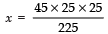
One of the numbers = 225Let the other number = xAlso LCM = 45 (HCF) ...(1)And LCM + HCF =1150⇒ (45 HCF) + HCF = 1150⇒ 46 HCF = 1150⇒ HCF = 1150/46 = 25From (1),LCM = 45 × 25∴ LCM × HCF = (45 × 25) × 25Now, LCM × HCF = Product of the numbers∴ x × 225 = (45 × 25) × 25⇒= 125Thus, the required number is 125.
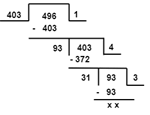
Q10: Three different containers contain 496 litres, 403 litres and 713 litres of a mixture. What is the capacity of the biggest container that can measure all the different quantities exactly?
For the capacity of the biggest container, we have to find the HCF.
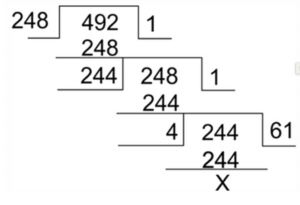
HCF: By Long Division method
First find the HCF of two numbers, 496 and 403The HCF of 496 and 403 = 31Now find the HCF of 31 and 713HCF of 713 and 31 is 31So, the maximum capacity is 31 liters.

Sol:
Let (5+3√2) is a rational number.∴ (5+3√2) = a/b [where 'a' and 'b' are co-prime integers and b ≠ 0⇒⇒⇒'a' and 'b' are integers,∴is a rational number.
⇒ √2 is a rational number.But this contradicts the fact that √2 is an irrational number.∴ Our assumption that (5+3√2) is a rational is incorrect.⇒ (5+3√2) is an irrational number.


Q12: Prove that 3-√5 is an irrational number.
Sol:
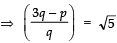
Let (3-√5) is a rational number.∴ 3-√5 = p/q , such that p and q are co-prime integers and q ≠ 0.⇒⇒Since, p and q are integers,∴is a rational number.
⇒ √5 is a rational number.But this contradicts the fact that √5 is an irrational number.∴ Our assumption that (3-√5) is a rational number' is incorrect.⇒ (3-√5) is an irrational number.


Q13: Show that there is no positive integer 'p' for which  is rational.
Sol:
If possible let there be a positive integer p for which
= a/b is equal to a rational i.e. where a and b are positive integers.
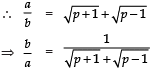
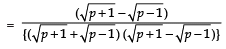
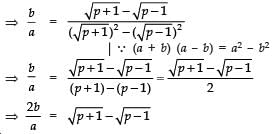
Now
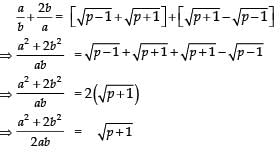
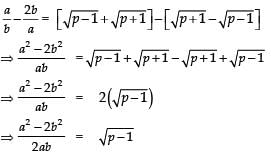
Also,Since a, b are integer
are rationals
⇒ (p + 1) and (p - 1) are perfect squares of positive integers, which is not possible (because any two perfect squares differ at least by 3). Hence, there is no positive integer p for which
is rational.
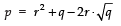
Q14: Prove that  is irrational, where p and q are primes.
Sol:
Letbe rational
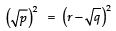
Let it be equal to 'r'i.e.Squaring both sides, we have
⇒⇒...(i)
Since, p, q are both rationalsAlso, r2 is rational (∵ r is rational)∴ RHS of (i) is a rational number⇒ LHS of (i) should be rational i.e.√q should be rational.But √q is irrational (∵ p is prime).∴ We have arrived at a contradiction.Thus, our supposition is wrong.Hence, √p+√q is irrational.

Unit Test
Time: 1 hour
M.M. 30
Attempt all questions.
- Question numbers 1 to 5 carry 1 mark each.
- Question numbers 6 to 8 carry 2 marks each.
- Question numbers 9 to 11 carry 3 marks each.
- Question number 12 & 13 carry 5 marks each.
Q4: State whether "√16" is a rational number or not. (1 Mark)
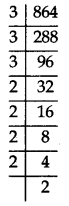
Q5:What is the prime factorization of 96? (1 Mark)
Q6: Prove that the square of any positive integer of the form (5k + 1) is one more than a multiple of 8, where "k" is an integer. (2 Marks)
Q7: Prove that √2 is irrational. (2 Marks)
Q8: Find the LCM (Least Common Multiple) of 15 and 20. (2 Marks)
Q9: Sonia takes 18 minutes to complete one round of a circular track, while Ravi takes 12 minutes for the same. If they start together from the same point, after how many minutes will they meet again at the starting point? (3 Marks)
Q10: Find the HCF (Highest Common Factor) of 72 and 96 using the prime factorization method. (3 Marks)
Q11: Check whether 6n can end with the digit 0 for any natural number n(3 Marks)
Q12: Given that p is a rational number and q is an irrational number, prove that their sum (p + q) is an irrational number. (5 Marks)
Q13: Prove that 5√3 - 3√75 is an irrational number. (5 Marks)
NCERT Solutions: Real Numbers (Exercise 1.1)
Checking, 7 × 6 × 5 × 4 × 3 × 2 × 1 + 5
HOTS
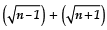 is rational.
 is rational.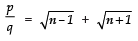
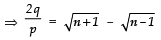
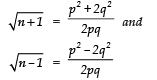
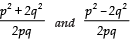 are rational numbers.
 are also rational.
i.e.  are perfect squares of +ve integers. It is not possible.
 is an irrational number, then show that
 is also irrational.
  be a rational number.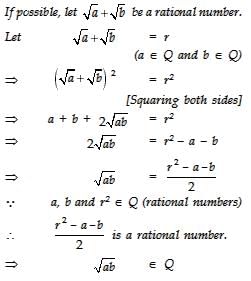
But it contradicts our assumption that is irrational. Thus,
 is irrational.
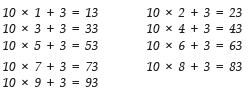
Thus, the required numbers are 13, 23, 43, 53, 73 and 83.
Value-Based Questions
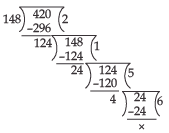
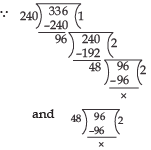
Very Short Answer Type Questions
Q1: For any two integers, the product of the integers = the product of their HCF and LCM. Is this relation true for three or more integers?
So, it will terminate after 4 places of decimals.
Since, least prime factor of a is 3, it implies that a is an odd number.
Similarly, b is also an odd number and we know that
odd + odd = even
So, a + b = even
The least prime factor of (a + b) is 2.
Short Answer Type Questions- I
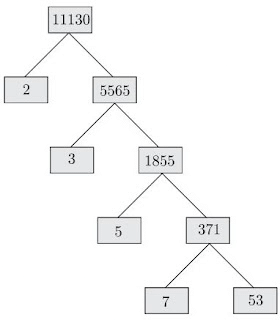
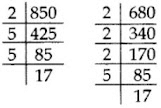
Q13: Find the LCM of 96 and 360 by using fundamental theorem of arithmetic.
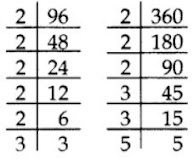
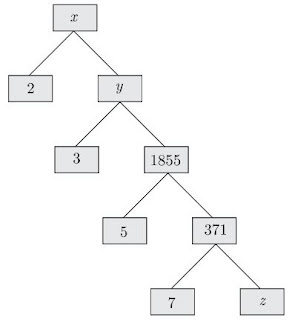
Short Answer Type Questions- II
Q23: Prove that 3 + 2√3 is an irrational number.
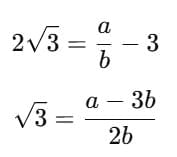
 is a rational number, since a and b are integers.
 would be rational.
But this contradicts the known fact that  is irrational.
Hence, our assumption was wrong.
Long AnsweType Questions
Case Based Type Questions
A. Read the following text and answer the following questions on the basis of the same:
To enhance the reading skills of grade X students, the school nominates you and two of your friends to set up a class library. There are two sections- section A and section B of grade X. There are 32 students in section A and 36 students in section B.
Try yourself: If p and q are positive integers such that p = ab2 and q = a2b, where a, b are prime numbers, then the LCM (p, q) is
Try yourself: If the product of two positive integers is equal to the product of their HCF and LCM is true then, the HCF (32 , 36) is
Try yourself: 7 × 11 × 13 × 15 + 15 is a
Try yourself: In a school there are two sections – section A and section B of Class VI . There are 32 students in section A and 36 in section B. Then, the minimum number of books required for their class library so that they can be distributed equally among students of section A or section B is ____.
A garden has 135 rose plants and 225 marigold plants.Find the sum of the exponents of the prime factors of the total number of plants.
- Exponent of 2 = 3
- Exponent of 3 = 2
- Exponent of 5 = 1
∴ Sum of exponents = 3 + 2 + 1 = 6.
Try yourself: A garden consists of 135 rose plants planted in certain number of columns. There are another set of 225 marigold plants, which is to be planted in the same number of columns.
Try yourself: Find the sum of exponents of the prime factors of the maximum number of columns in which they can be planted.
NCERT Solutions: Real Numbers (Exercise 1.2)
Very Short Answer Type Questions: Real Numbers
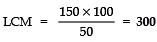
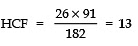
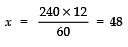
 will terminate after how many places of decimal?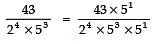
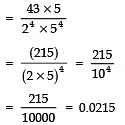
Thus,  will terminate after 4 places of decimal.
- A composite number can be broken down into prime factors.
- This factorisation is unique; the same primes can be arranged in different orders.
- For example, 2 × 3 × 5 is the same as 3 × 2 × 5.
This theorem is essential in number theory and has significant implications in various mathematical fields.
- Their decimal expansion does not terminate or repeat.
- They cannot be written in the form p/q, where q ≠ 0.
Examples of irrational numbers include: √2, √3, π
- The prime factorisation of q is not of the form 2n x 5m,
- where n and m are non-negative integers.

 will have a terminating or non-terminating repeating decimal expansion.
- If the prime factors of q are only 2 and 5, the decimal expansion is terminating.
- If q has any prime factors other than 2 or 5, the decimal expansion is non-terminating repeating.
 will have a non-terminating repeating decimal expansion.
Since the prime factorisation includes only the primes 2 and 5, it indicates that:
The decimal expansion of 17/3125 is a terminating decimal.
Long Answer Questions: Real Numbers
Sol:(a) HCF of 825 and 625825 = 3 x 5 x 5 x 11675 = 3 x 3 x 3 x5 x 5HCF = 3 x 5 x 5 = 75Maximum capacity reqired is 75 litres(b) The first tanker will require 875/75 = 11 times to fillThe second tanker will require 675/75 = 9 times to fill
Q2: The sum of LCM and HCF of two numbers is 7380.If the LCM of these numbers is 7340 more than their HCF. Find the product of the two numbers.
Sol: LCM + HCF = 7380LCM - HCF = 73402LCM = 14720LCM = 14720/2LCM = 7360LCM + HCF = 73807360+ HCF = 7380HCF = 7380 - 7360HCF = 20HCF x LCM = product of numbers20 x 7360= product of numbers147200 = product of numbers
Q3: If two positive integers x and y are expressible in terms of primes as x = p2q3 and y = p3q, what can you say about their LCM and HCF. Is LCM a multiple of HCF? Explain.
Sol: x = p2q3 and y = p3qLCM = p3q3HCF = p2q .....(i)Now, LCM = p3q3⇒ LCM = pq2 (p2q)⇒ LCM = pq2 (HCF)Yes, LCM is a multiple of HCF.Explanation:Let a = 12 = 22 × 3b = 18 = 2 × 32HCF = 2 × 3 = 6 ...(ii)LCM = 22 × 32 = 36LCM = 6 × 6LCM = 6 (HCF) ...[From (ii)]Here LCM is 6 times HCF.
Sol:Apply Euclid's Division Algorithm:Step 1: Divide the larger number by the smaller.225 = 135 × 1 + 90Step 2: Now divide 135 by 90.135 = 90 × 1 + 45Step 3: Now divide 90 by 45.90 = 45 × 2 + 0Since the remainder is now 0, we stop here.HCF = 45 (the last non-zero remainder)
Sol:(i) HCF of 28,16 and 12 is 4Therefore maximum number of books each student get is 4(ii) Number of maths books 28/4 = 7Number of science books 16/4 = 4Number of social science = 12/4 = 3Total books = 7 + 4 + 3 =14
Q6: Amita, Sneha, and Raghav start preparing cards for all persons of an old age home. In order to complete one card, they take 10, 16 and 20 minutes respectively. If all of them started together, after what time will they start preparing a new card together?
Sol: To find the earliest (least) time, they will start preparing a new card together, we find the LCM of 10, 16 and 20.10 = 2 × 516 = 2420 = 22 × 5LCM = 24 × 5 = 16 × 5 = 80 minutesThey will start preparing a new card together after 80 minutes.
Q7: Dudhnath has two vessels containing 720 ml and 405 ml of milk respectively. Milk from these containers is poured into glasses of equal capacity to their brim. Find the minimum number of glasses that can be filled.
Sol: 1st vessel = 720 ml; 2nd vessel = 405 mlWe find the HCF of 720 and 405 to find the maximum quantity of milk to be filled in one glass.405 = 34 × 5720 = 24 × 32 × 5HCF = 32 × 5 = 45 ml = Capacity of glassNo. of glasses filled from 1st vessel = 720/45 = 16No. of glasses filled from 2nd vessel = 405/45 = 9Total number of glasses = 25
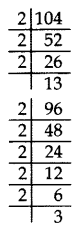
Sol:104 = 23 × 1396 = 25 × 3HCF = 23 = 8(a) Number of rows of students of class X = 104/8 = 13Number maximum of rows class IX = 96/8 = 12Total number of rows = 13 + 12 = 25(b) No. of students of class IX in a row = 8No. of students of class X in a row = 8(c) The objective of school administration behind such an arrangement is fair and clean examination, so that no student can take help from any other student of his/her class.
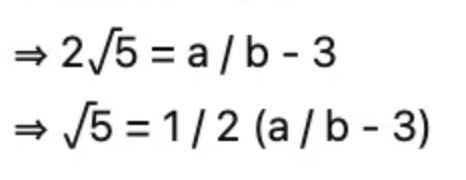
Q9: Prove that 3 + 2√5 is irrational.
Sol:Let us assume, to the contrary, that 3 + 2√5 is rationalSo that we can find integers a and b (b ≠ 0), such that3 + 2 √5 = ab, where a and b are coprime.Rearranging this equation, we get⇒ 2√5 = ab - 3 ⇒ √5 = a - 3b2b
⇒ √5 = a2b - 3b 2b ⇒ √5 = a2b - 3 2Since a and b are integers, we get that a2b - 3 2 is rational and so √5 is rational. But this contradicts the fact that √5 is irrational.So we conclude that 3 + 2√5 is irrational.
Q10: Prove that √5 is irrational.
Sol:Consider that √5 is a rational number.i.e. √5 = x/y (as well as, x and y are co-primes)y√5= xSquaring the both the sides, we observe,(y√5)2 = x2⇒5y2 = x2...................................... (1)Therefore, x2 is divided by 5, so x is also divided by 5.Consider, x = 5k, for some value of k and putting the value of x in equation (1), we observe,5y2 = (5k)2⇒y2 = 5k2is divisible by 5 it means y is divisible by 5.Clearly, x and y are not co-primes. Thus, our assumption about √5 is rational is incorrect.Hence, √5 is an irrational number.
Case Based Questions: Real Numbers
Q1: Read the source below and answer the questions that follow:
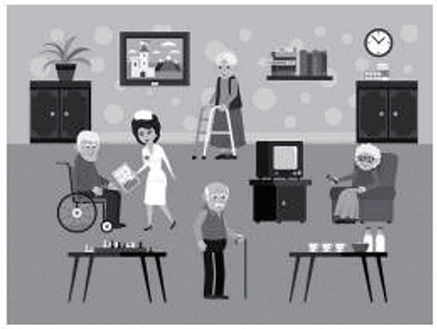
Old age homes mean for senior citizens who are unable to stay with their families or destitute. These old age homes have special medical facilities for senior citizens such as mobile health care systems, ambulances, nurses and provision of well balanced meals.
Q2: Read the source below and answer the questions that follow:
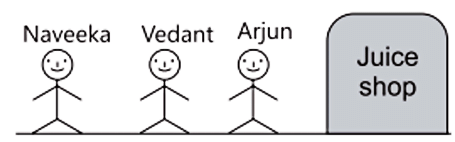
In a morning walk, Naveeka, Arjun and Vedant step off together, their steps measuring 240 cm, 90 cm, 120 cm respectively. They want to go for a juice shop for a health issue, which is situated near by them.
Q3: Read the source below and answer the questions that follow:
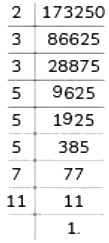
Q4: Read the source below and answer the questions that follow:
Assertions & Reason Type Questions: Real Numbers
Directions: In the following questions, a statement of assertion (A) is followed by a statement of reason (R). Mark the correct choice as:
Correct Answer is Option (a)As we know that square root of every prime number is an irrational number. So, both A and R are correct and R explains A.
Correct Answer is Option (d)Here reason is true , Assertion is false.We know that for any two numbers, Product of the two numbers = HCF x LCM = 18 x 169 = 3042 ≠ 3072
Question 3:
(a) Both assertion (A) and reason (R) are true and reason (R) is the correct explanation of assertion (A).
(b) Both assertion (A) and reason (R) are true but reason (R) is not the correct explanation of assertion (A).
(c) Assertion (A) is true but reason (R) is false.
(d) Assertion (A) is false but reason (R) is true.
Correct Answer is Option (d)12n = (2 x 2 x 3)n = 2n x 2n x 3n ,Its prime factors do not contain 5n i.e., of the form 2m x 5n , where m, n are natural numbers.Here assertion is incorrect but reason is correct.
Question 4: Assertion: The HCF of two numbers is 5 and their product is 150, then their LCM is 30
Reason: For any two positive integers a and b, HCF (a, b) + LCM (a, b) = a x b.
(a) Both assertion (A) and reason (R) are true and reason (R) is the correct explanation of assertion (A).
(b) Both assertion (A) and reason (R) are true but reason (R) is not the correct explanation of assertion (A).
(c) Assertion (A) is true but reason (R) is false.
(d) Assertion (A) is false but reason (R) is true.
Correct Answer is Option (c)
We have,LCM(a, b) x HCF(a, b) = a x bLCM x 5 = 150LCM 5/150 = 30
Question 5:
Correct Answer is Option (d)
Let us consider the assertion,∵ HCF × LCM = Product of numbers∴ 6 × LCM = 336 × 54⇒ LCM =336 × 546= 3024Thus, the assertion is incorrect:Now, let us consider the reason:Prime factors of 196 = 22 × 72∴ The sum of exponents of prime factors = 2 + 2 = 4.
So, the reason is correct:Thus, assertion is incorrect but reason is correct.
Correct Answer is Option (b)In case of assertion, Since, in the product of two consecutive positive integers, p = n(n + 1), one of n or (n + 1) is an even number.Hence, the product of two consecutive positive integers is divisible by 2. So, it is correct.Now, let us consider the reason:Since, the given number ends in 5. It is a multiple of 5. Therefore, it is a composite number.Thus, both assertion and reason are correct and reason is not the correct explanation for assertion.
Correct Answer is Option (c)Firstly consider the assertion,Since (7 × 13 × 11) + 11 = 11 × (7 × 13 + 1) = 11 × (91 + 1)= 11 × 92 ⇒ 11 × 2 × 2 × 23and (7 × 6 × 5 × 4 × 3 × 2 × 1) + 3 = 3 (7 × 6 × 5 × 4 × 2 × 1 + 1)= 3 × (1681) ⇒ 3 × 41 × 41Given numbers have more than two prime factors.So, both the numbers are composite. Hence, assertion is correct.Now let us consider the reason: 3 × 12 × 101 + 4 = 4(3 × 3 × 101 + 1)= 4(909 + 1)
= 4(910)
= 2 × 2 × 2 × 5 × 7 × 13= a composite number[∵ Product of more than two prime factors]Thus, reason is not correct.Thus, assertion is correct but reason is incorrect.
Correct Answer is Option (a)Let a, a2 and a3 be three numbers, then we have the smallest power of a1, a2 and a3 is 1. So, HCF is a.Now, let us consider the reason:Prime factors of 12 = 22 × 3Prime factors of 21 = 3 × 7Prime factors of 15 = 3 × 5∴ HCF of 12, 21 and 15 = 3, which is a common prime factor.Thus both assertion and reason are correct and reason is the correct explanation for assertion.
Correct Answer is Option (d)
In case of assertion:
151600
=152⁴ × 100=15 × 5⁴2⁴ × 5⁴ × 100=9375(2 × 5)⁴ × 100=93751000000= 0.009375So, assertion is incorrect.
Now, in case of Reason:
23
2³ × 5²=23 × 52³ × 5² × 5=1152³ × 5³=115(2 × 5)³=1151000= 0.115So, reason is correct.
Thus, assertion is incorrect but reason is correct.
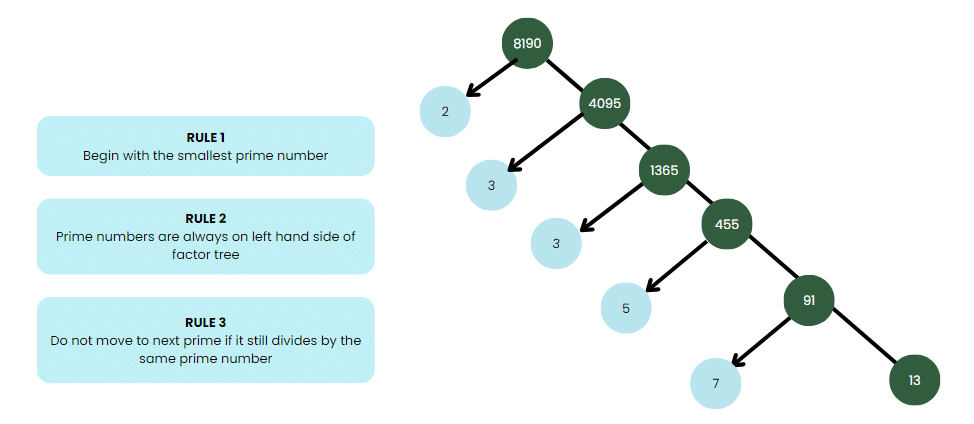
Visual Worksheet: Prime Factorisation (with Solutions)